Bret Easton Ellis
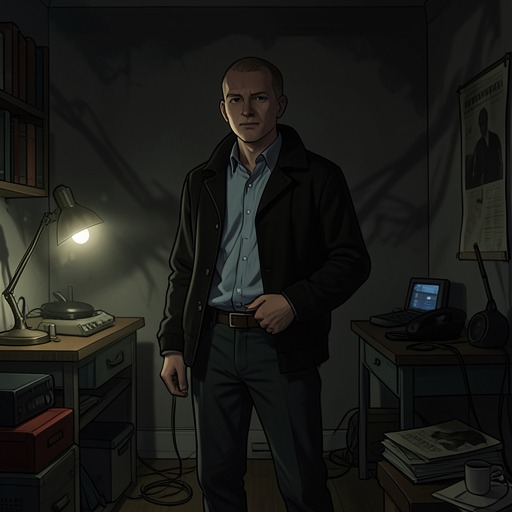
The ShardsBret Easton Ellis is the adult authorial narrator who revisits his senior year at Buckley in 1981, but the story he tries to write is also the experience he once could not bear to remember. His account makes that impasse central: the book’s long-delayed creation is bound to the return of memories involving Robert Mallory, the Trawler, and the people caught in the same traumatic year.
Identity and Narrative Position
In the retrospective frame, Ellis speaks as a writer looking back on his teenage self and on the friends with whom he began senior year at Buckley. He describes them as superficially sophisticated children who had experience without understanding what it meant. Only later, he suggests, did events force them into a more painful knowledge of the world. The distance between the adult narrator and the seventeen-year-old is therefore not simply chronological: it is also the distance between having lived through events and being able to interpret or narrate them.
Ellis presents the novel as a dream that demands to be written, comparing the pull of composition to falling in love: irresistible, risky, and capable of hurting someone. That metaphor gives the act of authorship a double character. Writing promises entry into the past’s romance, fantasy, and secrets, but it also threatens to reopen what the narrator has spent years trying to suppress.
Repeated Attempts to Write
Ellis first tried to write about the period a year after the events, when he was nineteen. He stopped almost as soon as he began, without writing a word: even gently remembering the people and what had happened to them, including what had happened to him, proved too unnerving. He forced himself to forget, and for a time the past was comparatively easy to erase from attention.
The project returned after he had lived in New York for more than twenty years and moved back to Los Angeles, the city where the events had taken place. He felt stronger and more resolved, and believed he could protect himself from the pain by entering the story. Instead, while making notes about autumn 1981, he drank Ocho to steady his trembling hands and suffered an acute anxiety attack. The effort to prepare the material had become a physical crisis rather than a controlled act of recollection.
The Memory’s Physical Return
The crisis came while Ellis was writing specifically about the Trawler, whose presence in the story reaches back to the late spring of 1980 and grows more pronounced in the summer of 1981. He understood the killer as frighteningly connected to his group of friends. As memories rose, he moaned with fear, collapsed, and vomited the tequila he had been drinking. Three Xanax tablets kept by his bed did not calm him quickly enough; convinced he was dying, he called 911 to report a heart attack and then fainted.
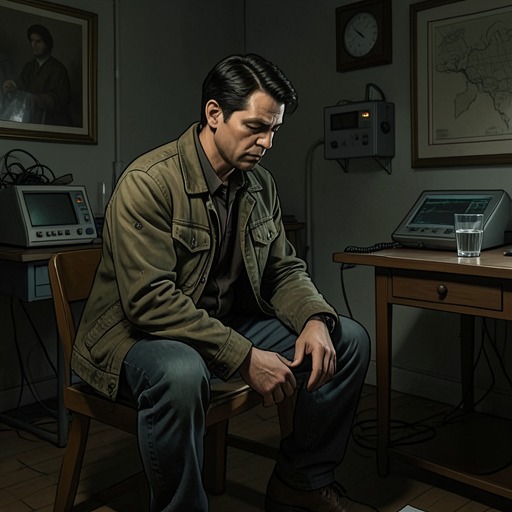
In 2006, at forty-two and living alone in a high-rise, Ellis was found on his bedroom floor after the doorman let the emergency medical team into his apartment. He regained consciousness in the ambulance on the way to Cedars-Sinai Medical Center. Once the medication took effect and he had reoriented himself, he felt embarrassed and recognized that nothing was physically wrong. He connected the panic directly to memories of the Trawler and, more particularly, Robert Mallory.
A doctor found him basically well, and the hospital proposed an overnight stay and further tests, including an MRI. Ellis declined them. He believed the episode arose not from a bodily illness but from memory: the year in question, Robert, the Trawler, Matt Kellner, Susan Reynolds, Thom Wright, Deborah Schaffer, and the dark passage through which he had been moving at seventeen. The recalled names make clear that the crisis belongs to a network of relationships and losses, not to an isolated recollection.
Delay, Return, and the Book’s Demands
After the 2006 episode, Ellis abandoned the project and wrote two other books over the following thirteen years. He describes the story as something he had pushed into a dark corner of the closet, along with Robert, the Trawler, and the people and events he had avoided. For a time, that avoidance worked: he paid less attention to the book, and it stopped calling to him.
The return began around 2019, and by 2020 Ellis felt able to begin The Shards. He frames this change not as a simple decision to resume the work, but as the book announcing itself and declaring Bret ready. That formulation preserves the tension running through his account: the author wants to control the telling, yet the past does not become available merely because he chooses to approach it. His narrative role is therefore also the role of a belated witness, whose attempt to make a story depends on facing memories that once made even the first notes impossible.